AI in Action · Jul 19, 2026 · 12 min read
AI in Action #3: When Readiness Needs Hard Gates
Shipping an AI demo is easy; shipping AI people can trust is harder. Eight dimensions, deterministic scores, and hard gates the model can't talk its way past.
Shipping an AI demo is easy. Shipping AI people can trust is harder — especially when a model is willing to narrate confidence the system has not earned.
AI Production Readiness Advisor is AI in Action #3, after RetireCheck and SleepCheck: a live advisory assessment that scores eight dimensions, applies hard gates, and returns an evidence-backed narrative—without pretending a checklist is a compliance stamp. Live at readiness.weidong-shi.com.
The engineering process — intent, boundaries, review, and shipping discipline — is the durable product. The application proves that process when the risk is inflated readiness.
Advisory disclaimer: Not a certification, audit, or legal opinion. Use the report as a structured conversation starter with engineering, security, and compliance teams—not as sign-off.
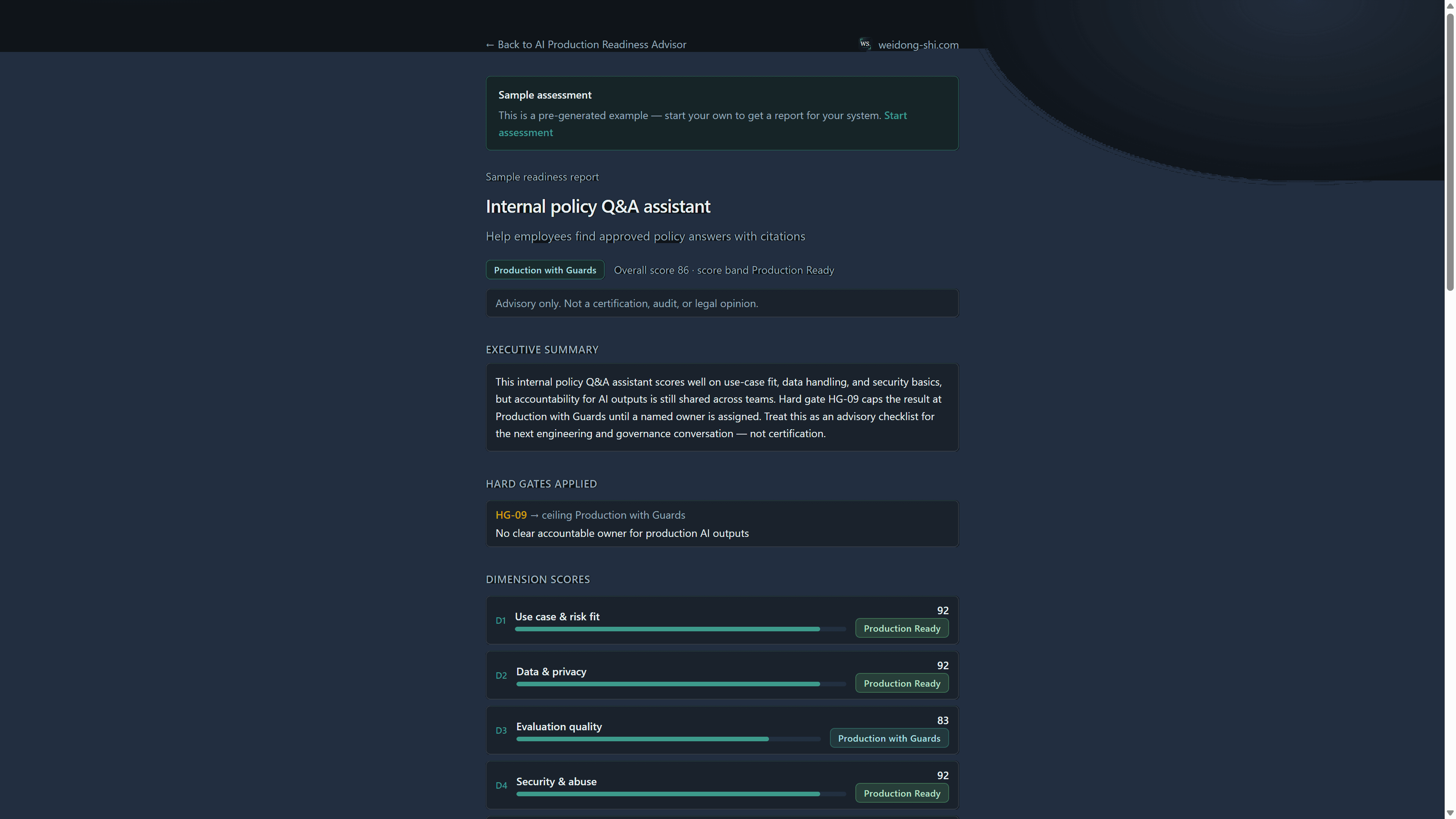
The product journey
Every AI in Action application follows the same methodology: Build → Validate → Improve → Document → Share. Readiness is one full pass through that loop — from a production readiness conversation to a live assessment, sample report, and public write-up. The cold-start artifact matters: visitors can open a pre-generated sample report before spending a wizard run or an OpenAI call.
The problem
Teams ship AI features faster than they can answer a simple question: is this ready for production? Checklists live in slides. Scores get hand-waved. Hard constraints—ownership, evals, abuse paths—get deferred until after launch.
I wanted the opposite of a certification theater: a guided assessment that makes ceilings visible, keeps answers in the browser, and lets a model narrate risk without ever deciding the band.
Design principles
- Scores and hard gates before narrative
- Server recompute — never trust a client band
- Hard gates the model can't talk its way past
- Advisory framing everywhere — no certification claims
- Browser-held answers; transient server processing
- Degraded scores-only mode when the model fails
- Fixtures prove gates; demos do not invent compliance
These principles became the architectural constraints that guided every engineering decision and every AI prompt.
The model creates capability. Architecture creates trust.
What shipped
Eight readiness dimensions:
- Use-case & risk fit
- Data & privacy
- Evaluation quality
- Security & abuse
- Reliability & ops
- Observability
- Human oversight
- Cost & performance
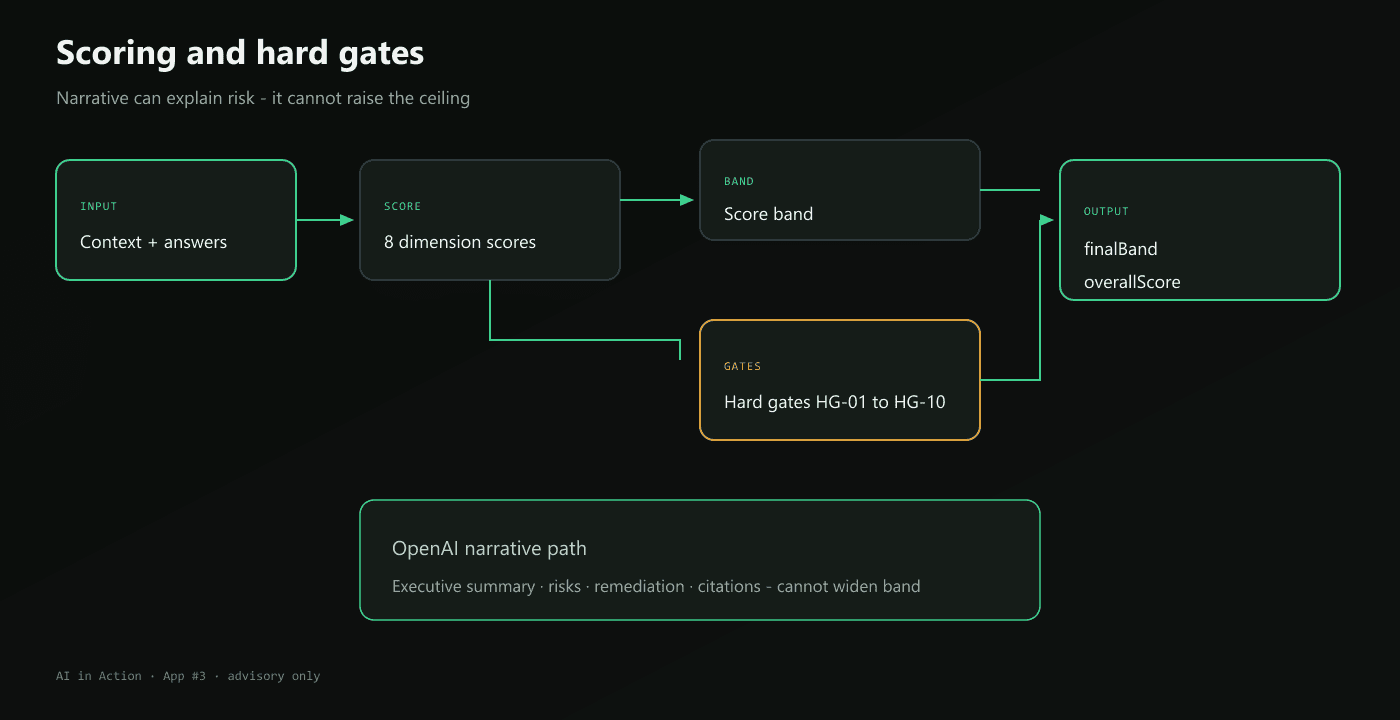
- Deterministic bands with hard gates HG-01…HG-10
- OpenAI advisory narrative with corpus citations
- Schema-repair retry and scores-only fallback
- Pre-generated sample report at /sample
- Markdown, JSON, and print/PDF export
- Dark/light theme parity with series chrome
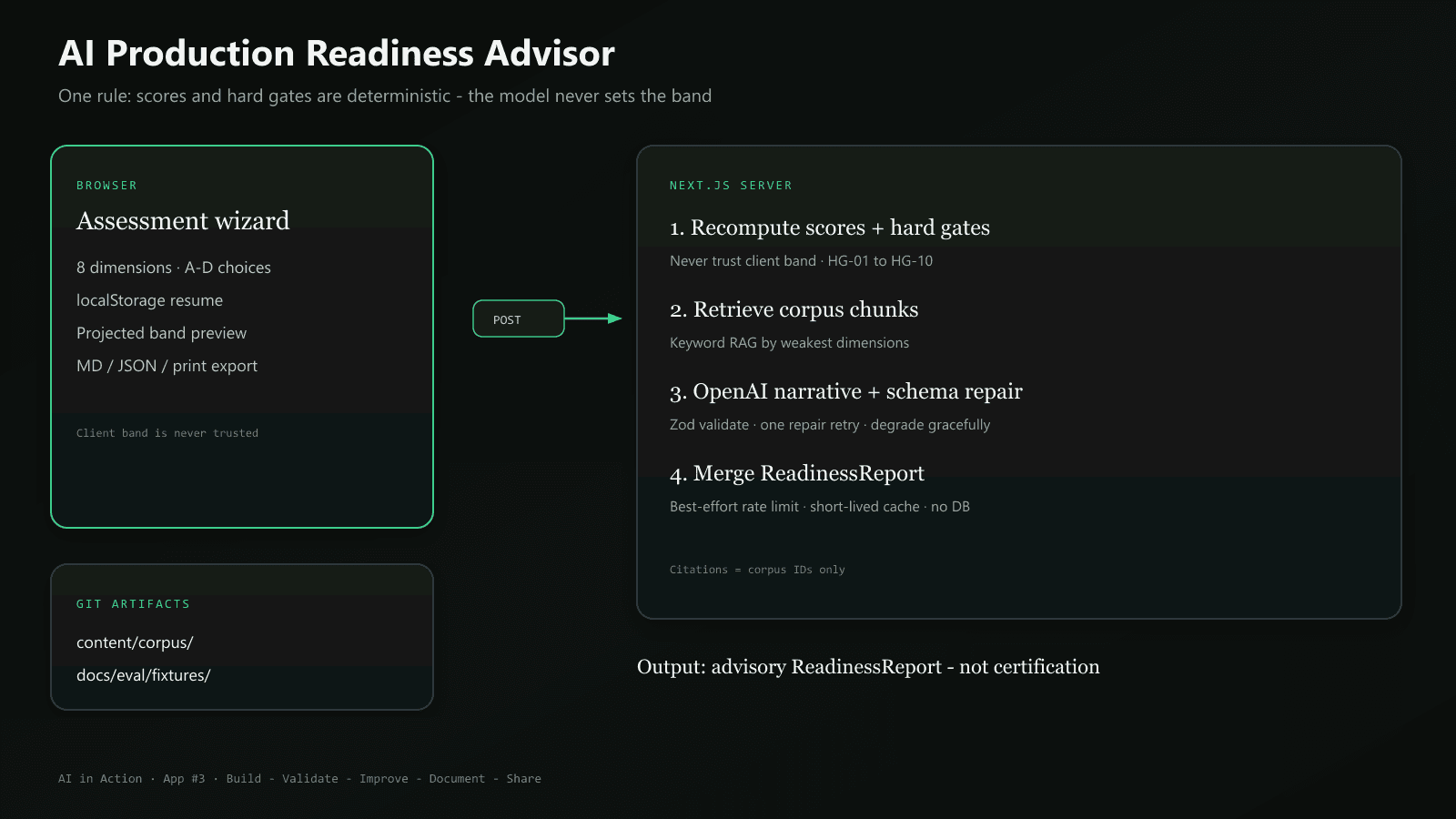
Reference architecture
RetireCheck centered on deterministic financial math. SleepCheck centered on uninterrupted sensory experience. Readiness centers on a trust boundary: the model may explain risk; it may not raise the ceiling.
Different products deserve different architectures.
One rule: scores and hard gates are deterministic and recomputed on the server; the model never sets the band.
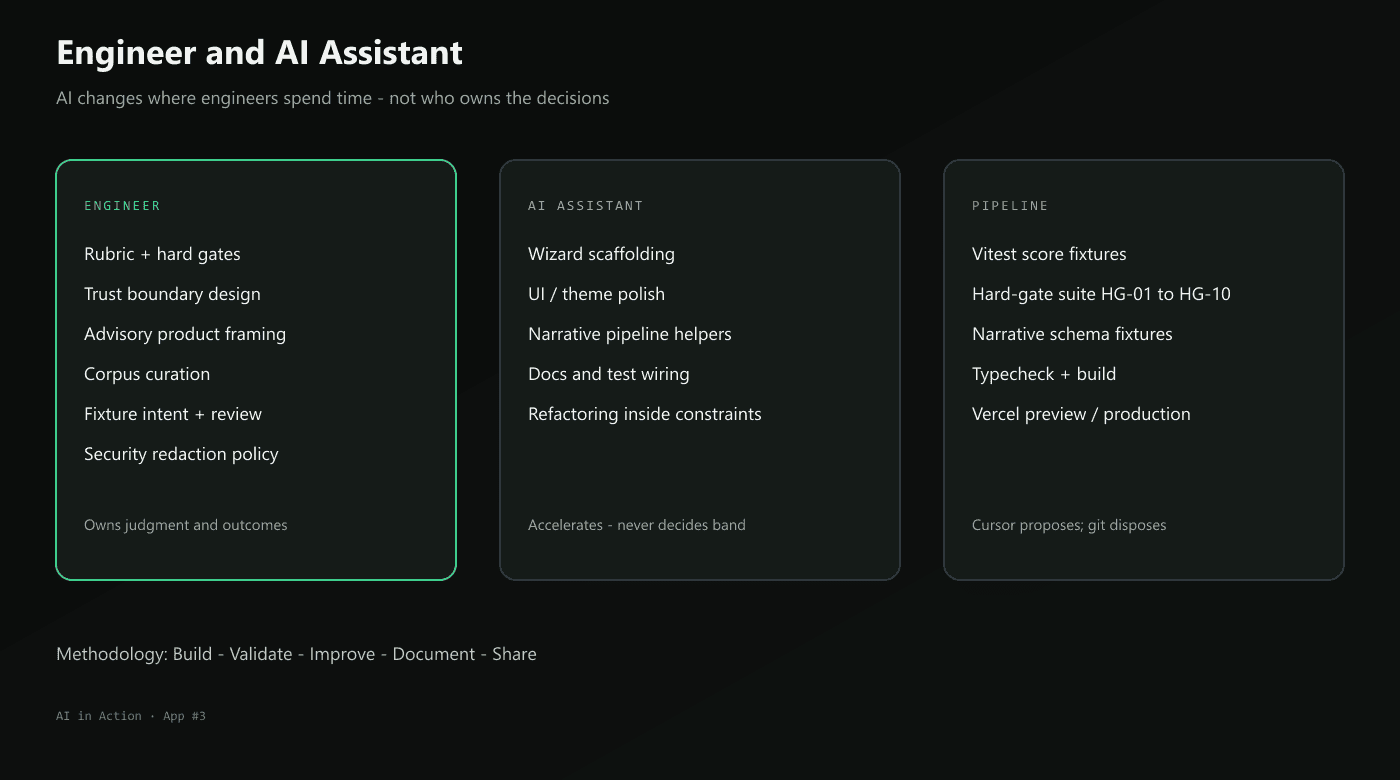
Engineer and AI Assistant
The workflow is intent-driven. The engineer owns the rubric, hard-gate ceilings, trust model, advisory product boundary, corpus selection, and fixture intent. The AI assistant accelerates scaffolding, UI polish, pipeline wiring, and docs—never production judgment over band or certification language. Vitest fixtures, typecheck, build, and deploy gates dispose of every meaningful change.
Testing what matters
Users rarely notice elegant prompts. They notice:
- a band that feels inflated
- a hard gate that did not fire
- injection text that somehow “improved” readiness
- a narrative that contradicts the deterministic score
Quality therefore includes Vitest fixtures for scoring, hard-gate ceilings, band boundaries, and narrative schema safety—not just a happy-path demo. The server recomputes scores so a client cannot self-award a band; when the model fails, scores-only fallback still returns a trustworthy report. Preview deployments make review concrete: open the build, run the sample, and try a guardrail path.
Takeaways
- Put band and gate authority in code before you invite a model to narrate.
- Hard gates teach more than raw scores—ceilings make risk visible.
- First-run trust needs a sample artifact; do not require a full wizard to see value.
- AI accelerates implementation.
- Engineers remain responsible for judgment.
- The highest leverage now comes from architecture, validation, and honest product boundaries.
Closing
RetireCheck, SleepCheck, and Readiness solve very different problems. Yet all three follow the same engineering philosophy: Build → Validate → Improve → Document → Share. That is the foundation of the AI in Action series.
Every application explores a different domain while demonstrating the same engineering discipline. AI accelerates software delivery. Experienced engineering judgment shapes the final product.
If you're also exploring AI-assisted software engineering, I'd enjoy hearing how you're approaching architecture, evaluation, and production readiness.