AI in Action · Jul 7, 2026 · 16 min read
AI in Action: Building RetireCheck with Cursor
How practical engineering, domain architecture, and AI-assisted development shipped a production retirement calculator — from wizard UX to Monte Carlo projections.
I built a production-ready app in about a day of focused effort, spread over a weekend. I didn't write most of the code — but I made every architectural decision. That distinction is the whole story.
RetireCheck is AI in Action #1 — from empty repo to deployed production app (frontend on Vercel, API on Render, tests and CI green) through intent-driven vibe coding: rules plus one-line prompts, with the pipeline enforcing quality. Vibe coding gets you a demo. Intent plus guardrails gets you production.
The product journey
Every AI in Action application follows the same methodology: Build → Validate → Improve → Document → Share. RetireCheck was the first full pass — prove the loop on a high-stakes domain (retirement math) before applying it to wellness and AI readiness.
The problem
People quietly worry about one question: will your money last? Advisor-grade tools are heavy. Spreadsheet guesses ignore sequence of returns, Social Security timing, RMDs, and Medicare IRMAA. A credible answer needs simulation — and the math must live somewhere that can be tested, not in a React component the AI rewrote overnight.
Design principles
Before asking Cursor to write a single component, I wrote the rulebook. The highest-leverage line in the repo:
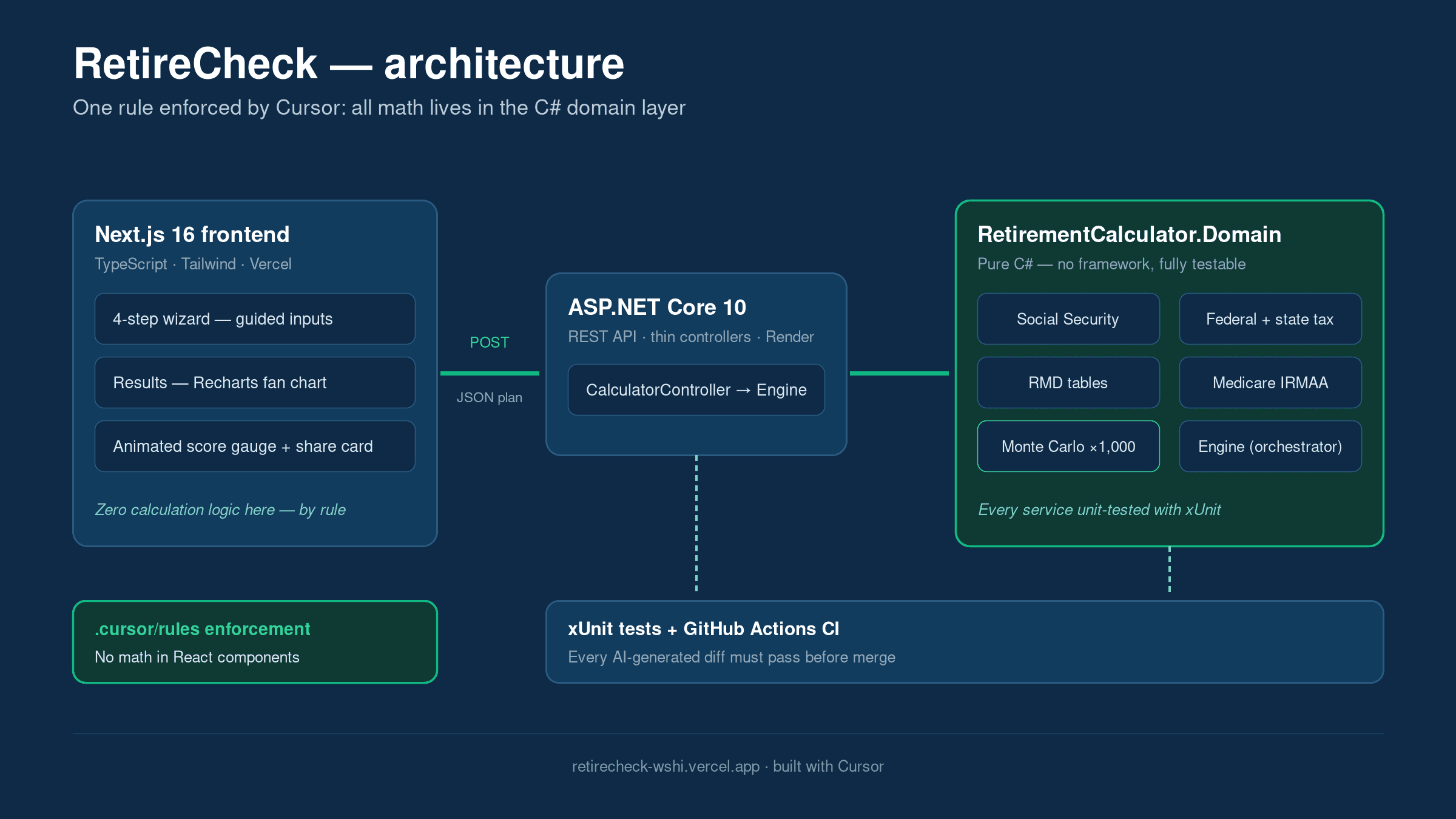
All financial math lives in RetirementCalculator.Domain. No calculation logic in React components or API controllers.
- Pure domain layer before UI scaffolding
- Ranges and sample plans before forcing exact numbers
- Estimates only — not financial advice — on every surface
- No account; inputs used for the request, not stored as a plan
- CI and xUnit on Social Security math before trusting a demo
What shipped
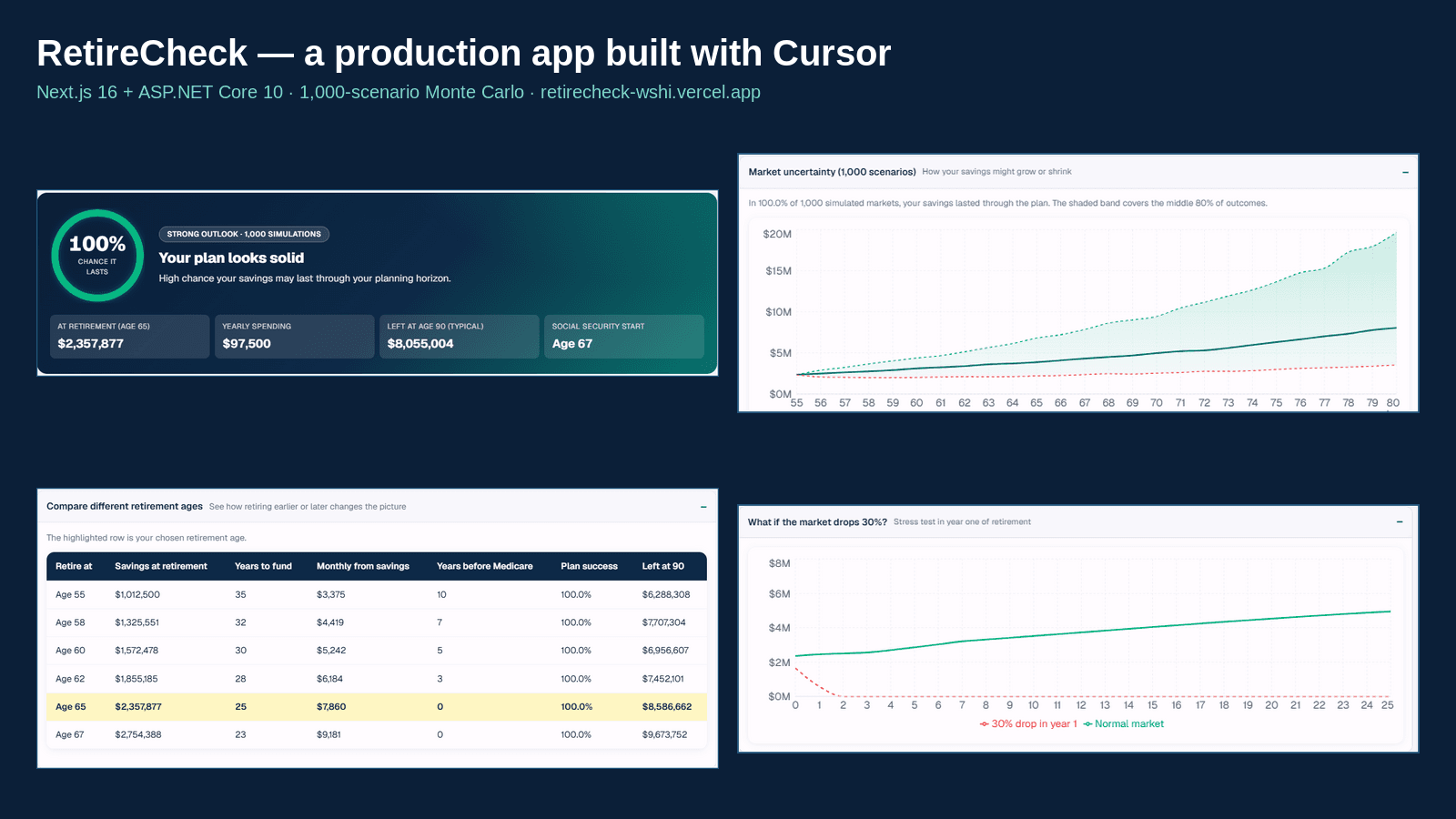
RetireCheck is a free US retirement calculator: a four-step wizard, 1,000-scenario Monte Carlo, Social Security claiming comparison, and year-by-year federal/state tax, RMD, and IRMAA projections — with a shareable readiness score card.
Stack: Next.js 16 + TypeScript + Recharts (Vercel) · ASP.NET Core with a pure C# domain library (Render) · xUnit · GitHub Actions CI.
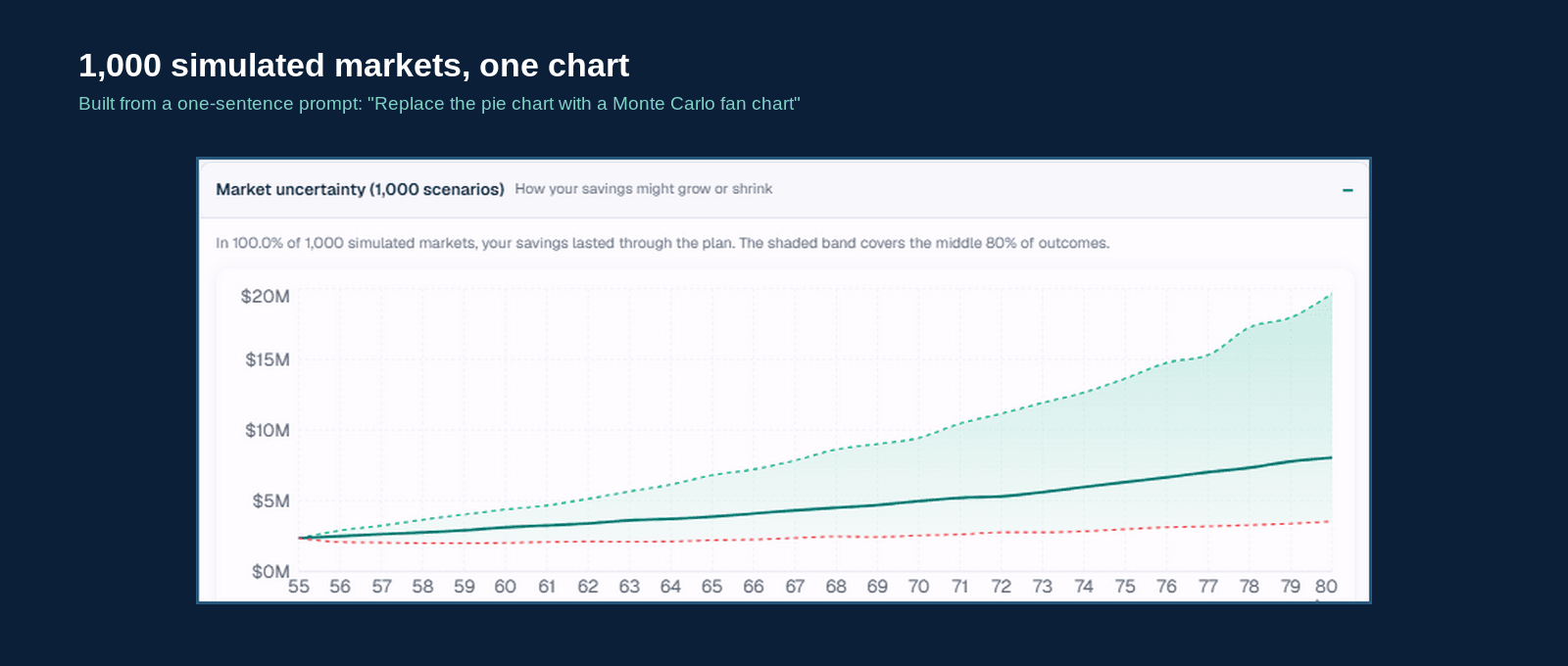
Monte Carlo fan chart. One sentence — “Replace the pie chart with a Monte Carlo fan chart — shaded P10–P90 band, median line, open by default” — produced a Recharts composed chart. Review, typecheck, tests, ship.
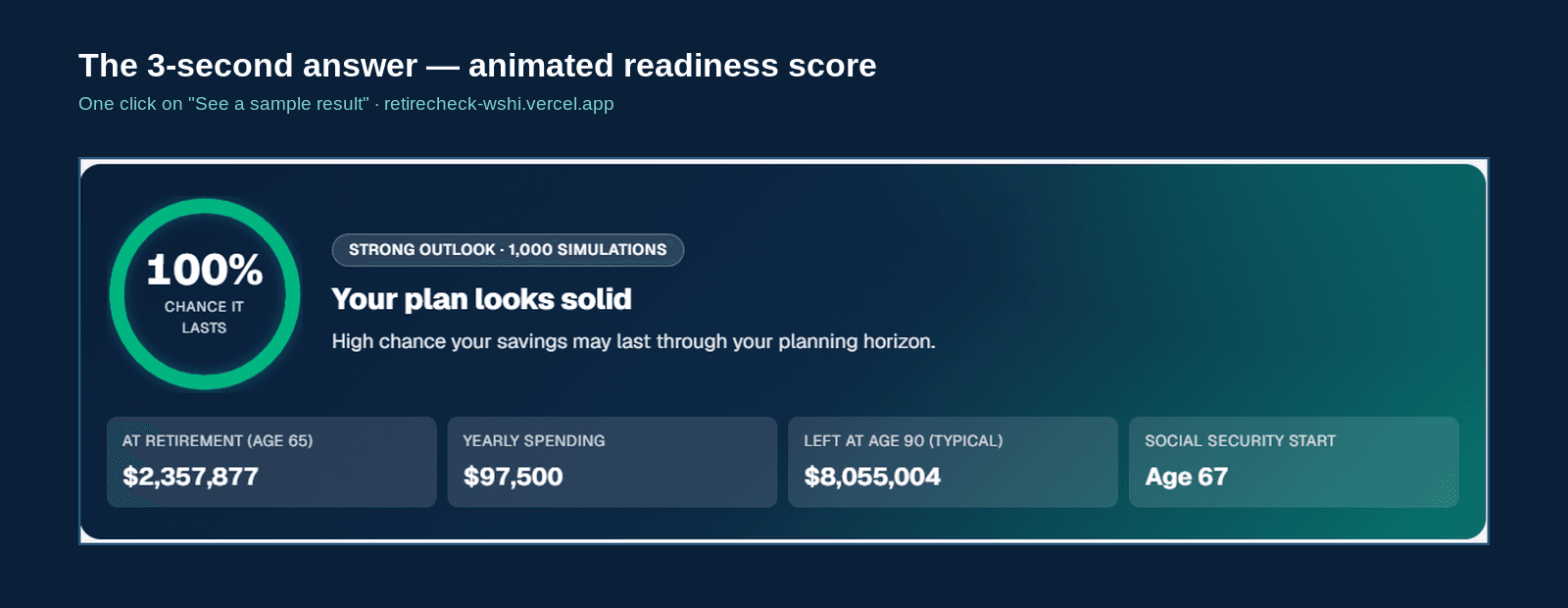
One-click sample plan. Most visitors from a social feed will not fill a four-step form. A sample-plan button wires a realistic profile through the same API path — still no calculation logic in the UI.
Reference architecture
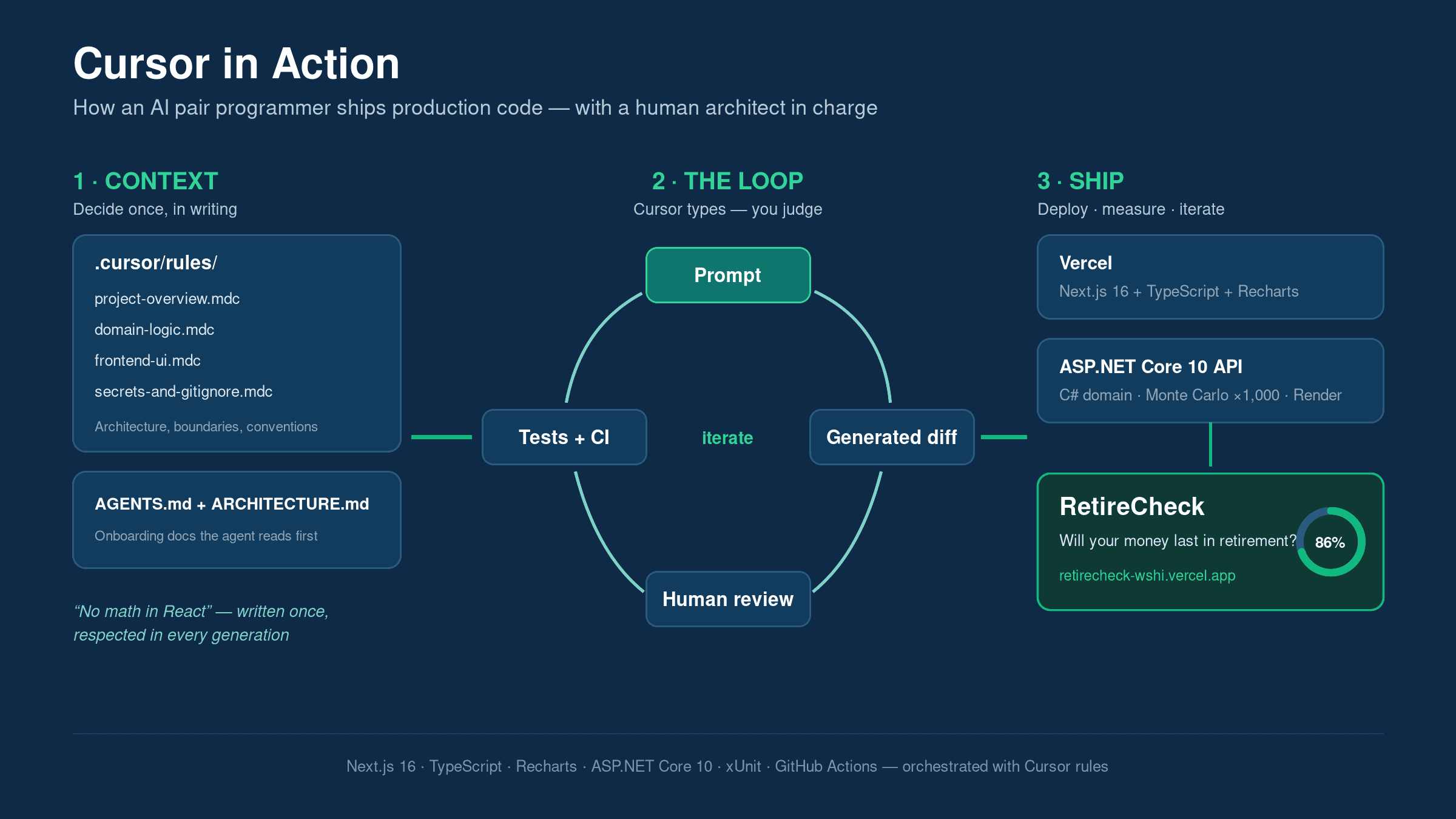
That domain boundary keeps every tax bracket, Social Security adjustment, and Monte Carlo run in a pure, unit-testable C# library. The React layer stays a thin rendering shell — so there is no “AI spaghetti” where a tax formula quietly lands in a component. The Next.js app proxies to the API; browsers never call the calculation engine directly.
Engineer and AI Assistant
- Engineer — product question, domain boundary, API contract, disclaimer language, review of every diff.
- AI Assistant — scaffolding, UI exploration, chart wiring, docs — inside the rules.
- Pipeline — typecheck, xUnit, and CI dispose of every meaningful change. The assistant proposes; git and CI dispose.
Testing what matters
Visitors notice wrong Social Security math and silent UI formulas — not elegant prompts. Failure modes we designed against:
- Tax or SS logic drifting into React
- Sample plan bypassing the real API path
- CI green while domain tests are skipped
xUnit covers Social Security math and validation; GitHub Actions runs on every push. That is the minimum bar for “production” when money is on the screen — estimates only, but still trustworthy estimates.
Takeaways
- Write rules before prompts.
- Isolate business logic in a pure, testable layer.
- Review diffs — never trust-and-paste.
- Ship something real; deploys teach.
- Your value moves up the stack: boundaries, contracts, tests, taste.
Closing
RetireCheck was the first full pass of the AI in Action loop: Build → Validate → Improve → Document → Share. SleepCheck follows the same philosophy in a different domain — proof that the methodology travels.
AI accelerates software delivery. Experienced engineering judgment shapes the final product.